To understand the US monetary system one needs to understand the system below, that is the flows and stocks of money.
\tikzset{
    table nodes/.style={
        rectangle,
        draw=black,
        align=center,
        minimum height=7mm,
        text depth=0.5ex,
        text height=2ex,
        inner xsep=0pt,
        outer sep=0pt
    },
    table/.style={
        matrix of nodes,
        row sep=-\pgflinewidth,
        column sep=-\pgflinewidth,
        nodes={
            table nodes
        },
        execute at empty cell={\node[draw=none]{};}
    }
}
\begin{tikzpicture}
  \matrix (first) [table, column sep=2mm, row sep=1mm] {
    \node [rectangle, draw=black, rounded corners=3, text width=4cm, text centered] {Federal Reserve}; &
    \\
    \node (A) [rectangle, draw=black, rounded corners=3, text width=2cm, anchor=east, text centered] {Treasury}; &
    \node (B) [rectangle, draw=black, rounded corners=3, text width=2cm, anchor=east, text centered] {Banks};
    \\
    \node [rectangle, draw=black, rounded corners=3, text width=5cm, text centered] {Corporations and Individuals}; & \\
  }

\end{tikzpicture}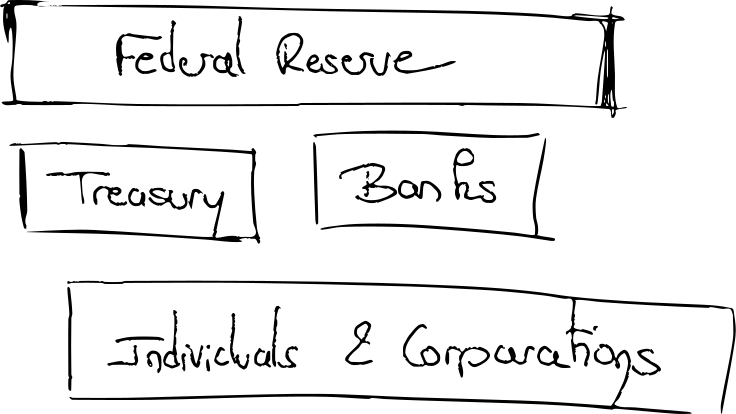
Treasury (debt) and Fed (monetary policy) were separated in 1951. See this article for an explanation of how they interact with each other in practice.
The banks:
- How much money can they loan? What are the reserve requirements?
- How can they acquire reserve?
For everything related to reserve requirements, you can read the Fed’s explanation of reserve balance requirements (PDF). This includes reporting timelines.
The treasury:
- How does it get money?
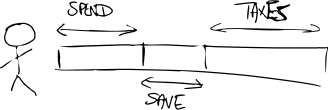
Individuals pay taxes, spend money and save money. Saving increases the reserves. Since Bale III banks are required to also hold High Quality Assets as reserve, often sovereign debt.